The Critical 3 Chapter Check

The Critical 3 Chapter Check

Why we have written this article...

Unfortunately, we continue to receive manuscripts from independent authors who believe their book is ready to publish. Sadly, upon reviewing their manuscript, we find hundreds of errors that really should not be in the finished, ready-to-publish book.

What we find distressing is that some of these authors have paid, in some cases, substantial 'professional' fees to third parties to review, audit and edit their book.

Despite paying these fees for proof reading and corrective services, some of the manuscripts we receive are still full of spelling and grammar errors, character and plot inconsistencies and sometimes a little confusion and contradiction within the narrative.

In an effort to remedy this and provide a bit of advice and guidance, as well as a prfactical tool, this article is split into two sections:

1 - Three chapters in? - Why It's time to take stock.

Why it is critical to stop writing once you have written, and after self-editing, are happy with your first three chapters, or 1,000 words.

2 -The Three Chapters in Editorial Pack

Using our "3-Chapters in Editorial Pack" to provide an independent check of your manuscript, not just the spelling and grammar, but the key aspects of your writing that you need to check before continuing to write or submitting your pitch to a literary agent or Publisher.

Critical 3-Chapters-In Checkpoint

Three chapters in? - Why It's time to take stock.

Pausing your writing after three chapters, about one thousand words, lets you check that the story you are actually writing matches the story you think you are writing, before you invest tens of thousands more words in the wrong direction.

Why is doing this Critical 3-Chapter Check so important for your book?

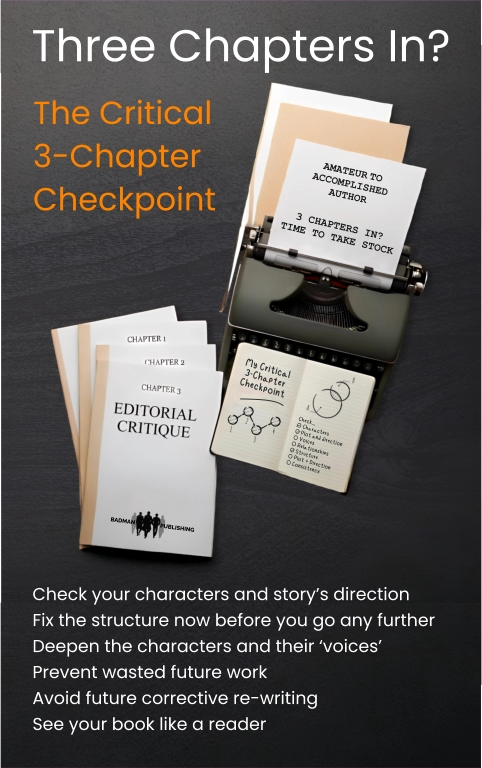
The Critical 3 Chapter Check featured image for Badman Publishing

Check your story's direction

Those first chapters usually establish the premise, protagonist, and problem, so pausing lets you confirm the book has a clear hook and direction rather than a vague situation.

A short 'stock‑take' helps you see whether each chapter genuinely pushes the story forward, or whether you are wandering, repeating beats, or stalling in backstory and exposition.

Fix the structure now before you go any further

Three chapters is often enough to reveal structural issues like a slow start, unclear stakes, or missing inciting incident, which are far easier to fix now than after 60k words.

Looking at these chapters side‑by‑side lets you assess pacing and balance between scene, summary, and exposition so the opening act leads naturally into the middle of the book.

Deepen the characters and their 'voices'

By chapter three you usually understand your characters better than you did on page one, so revisiting the opening allows you to align their early behaviour and dialogue with who they have already become.

A pause helps you smooth out shifts in style or tone that creep in as you warm up, giving the book a more consistent narrative 'voice' from the outset.

Prevent wasted future work - avoid future corrective re-writing

Taking stock can expose dead‑end subplots or worldbuilding ideas now, so you can adjust your informal outline or notes instead of cutting entire later chapters.

Even if you are discovery writing, a brief review of what you have teaches you what the story wants to be, making future scenes easier and reducing the amount of heavy revision needed later.

See your book like a reader

Stepping back, even for a short time, lets you return to those chapters with enough distance to spot confusion, flat moments, or missing emotional beats that you were blind to while drafting.

Reading the first three as a continuous unit gives you a reader’s‑eye view of your opening act: would you, as a stranger, feel compelled to keep turning pages into chapter four?


The 3-Chapters-In Editorial Pack

Editorial Pack Featured image for Badman Publishing

To help you "take stock" of your story so far, you can upload the first three chapters of your manuscript.

We will analyse your submitted first three chapters and present you with the following:

1. A focused spelling and grammar check highlighting errors to remedy.

2. A full critique providing a critique of your story, checking character development, plot line, and writing style.

3. A one-page pitch document based on your first three chapters

4. A storyline and plot planner to help you refine and adhere to the plot lines and time lines

5. Access to our writing and publishing focused resources

The Editorial Pack (COMING 2026)

Click here for more information about your bespoke editorial pack contents, example documents and pricing. (Available January 2026)

[dsm_icon_list _builder_version="4.27.5" _module_preset="default" global_colors_info="{}"][/dsm_icon_list]
Please feel free to share this page... Thanks :-)
The Best Print on Demand Platform for Paperback Books in 2025

The Best Print on Demand Platform for Paperback Books in 2025

The best print-on-demand platform for paperback books in 2025

The self-publishing industry continually evolves, and choosing the right print on demand company for paperback books is crucial for indie authors navigating this competitive landscape. In a recent comparative review, five prominent self-publishing companies were put head-to-head: Amazon Kindle Direct Publishing (KDP), IngramSpark, Barnes & Noble Press, Lulu Publishing, and Draft2Digital. This analysis focused on key factors, ranging from costs and royalties to user-friendliness and distribution.

Cost to Print and Publish

For a 5.5" x 8.5" paperback with consistent print specifications, the cost to print varied significantly:

KDP was the most affordable, while Lulu ranked as the priciest.

Publishing fees are largely waived on platforms like KDP, Barnes & Noble Press, and Lulu unless ordering a personal copy.

IngramSpark now offers free publishing and revisions within the first 60 days but charges $25/revision thereafter. Draft2Digital allows free updates every 90 days, with a paid “token” option for faster changes.

Uploading Process

KDP’s process stands out for its Word document and cover templates, digital proofing, and straightforward file approval, though the “Not-For-Resale” proofs can frustrate authors seeking review or promotional copies.

IngramSpark’s process is notably finicky regarding file specs and requires full approval before proofing. Barnes & Noble Press offers downloadable cover templates during upload and a PDF preview, whereas Lulu and Draft2Digital feature digital flip-through previews for uploaded files.

Royalties

Royalties were calculated based on a £9.99 list price:

  • KDP and IngramSpark (with a lower wholesale discount) offer the highest payouts per sale.
  • Lulu’s broad distribution means authors need to raise list prices to break even, but direct sales via Shopify or Lulu’s bookstore offer more lucrative returns.
  • Draft2Digital’s royalty structure still needs improvement and delivered the lowest per-sale earnings.

Print Quality

All five platforms produced nearly identical books, with minor differences in cover color accuracy and binding.

There’s an interesting overlap; Barnes & Noble Press, IngramSpark, and Draft2Digital all utilize Lightning Source’s printing facilities, ensuring similar quality for standard orders.

Lulu’s interiors delivered the clearest, boldest print, but images in books from IngramSpark and Barnes & Noble Press displayed slight pixelation.

Print Options

KDP and IngramSpark allow custom trim sizes within specific ranges, while Barnes & Noble Press limits choices to 21 fixed sizes.

Ink and paper options vary, with IngramSpark providing the most flexibility for paper weights and finishes.

User-Friendliness

KDP leads in ease of use and tutorial support thanks to its popularity and robust online resources.

IngramSpark has improved its dashboard but still poses challenges for new users, especially when tracking royalties and compensation.

Draft2Digital is user-friendly for those well-versed with its platform; newcomers may face a learning curve.

Customer Service

KDP offers responsive support via email and phone, resolving most issues efficiently. However, automated account suspensions driven by software checks can be problematic.

IngramSpark’s support is mostly unhelpful, with slow email responses and paid phone support focused more on uploading guidance than issue resolution.

Barnes & Noble Press and Lulu rely on email support, while Draft2Digital provides both phone and email contacts, with questionable effectiveness.

Distribution

KDP dominates Amazon but offers limited "expanded distribution" with reduced royalties.

IngramSpark shines in worldwide reach, enabling orders from nearly any retailer or library.

Barnes & Noble Press makes books available online and in physical stores (upon request).

Lulu offers global distribution and direct integration with Shopify.

Draft2Digital matches IngramSpark’s breadth, listing books across Amazon and major bookstores.

Summary

Choosing the best print on demand company for paperback books depends on your priorities:

KDP is ideal for affordability, user-friendliness, and Amazon-centric distribution.

IngramSpark excels in global reach but may frustrate with technical requirements and support.

Barnes & Noble Press and Lulu offer their own niches — Lulu for print clarity and direct sales integration, Barnes & Noble for targeted store availability.

Draft2Digital is an emerging option, especially for authors already using the platform for ebooks.

A recommended strategy is to perfect your book on KDP first before considering extended distribution through IngramSpark or Draft2Digital. Pre-orders remain tricky, with mixed reviews regarding reliability.

Our Advice:

For most indie authors, starting with KDP makes sense for ease, cost, and return. But for broader distribution and bookstore/library access, consider adding IngramSpark after your initial launch.

Can we help you with writing, refining and/or publishing?

At Badman Publishing, we understand that navigating the world of independent publishing can be overwhelming — especially when it comes to budgeting for professional services. That’s why we’re committed to making your journey smoother, more affordable, and more empowering.

Whether you're looking for editorial support, design expertise, publishing guidance, or marketing tools, we offer a range of services, some of which are free, or low cost — tailored to independent authors like you. Our goal is to help you focus on what matters most: writing and sharing your story.

We’re here to support you. Reach out to us at Badman, or explore our resources and services pages to see how we can collaborate.

"Let’s bring your book to life — together."

The publishing cycle v2 Badman Publishing
Please feel free to share this page... Thanks :-)
How much do professional services cost Independent Authors (2025 report)

How much do professional services cost Independent Authors (2025 report)

Let’s dive into DIY v Pro services for Indie Authors

One of the many considerations for independent authors is the comparison between doing everything yourself, or using professional services, or a combination of the two.

As a not-for-profit publisher, Badman Publishing is happy to help by providing services on a free or cost basis to its authors/members. However, we thought it might be useful to research and illustrate the services provided by professionals and agencies, and the average prices that an independent author can expect to pay.

The report below is a well-rounded list of services these companies provide and the average/typical prices of those services in £GBP. Please note: These are not Badman prices; they are the average one can expect to be charged by commercial freelancers and agencies.

Editorial Services

  • Manuscript critique (up to 20,000 words): £250

  • Content/Developmental Editing (up to 20,000 words): £650

  • Copyediting (up to 20,000 words): £350

  • Proofreading (up to 20,000 words): £200

    • For longer manuscripts (e.g., 80,000 words):

      • Critique: £1,000

      • Content editing: £2,500

      • Copyediting: £1,500

      • Proofreading: £800

  • Alternatively: per 1,000 words

    • Editing: £5.70

    • Proofreading: £3.70


Formatting & Layout

  • Print book typesetting: from £300

  • eBook conversion: from £250

  • Table of contents setup, typography, and layout: usually included in typesetting/package


Graphic Design

  • Premade covers: £50 – £150

  • Custom photographic cover: £150 – £350+

  • Custom illustrated cover: £350 – £1,600+

  • eBook-only cover: from £144.44

  • Paperback cover: from £213.33


Publishing Support

  • ISBN registration: typically included in publishing packages (or £50–£100 if standalone)

  • Metadata/keywords optimization: £50–£100

  • KDP/IngramSpark upload support: £60–£150/package


Marketing & Promotion

  • Amazon Author Central setup: £50–£100

  • Social media graphics: £25–£75 per graphic

  • Press release or author bio: £60–£150

  • Book launch package: £200–£400

  • Newsletter design: £75–£150


Author Branding & Growth

  • Author website (basic WordPress): £350–£1,200

  • Author logo design: £75–£250

  • Professional author photo edit: £30–£75 per image


Additional Support
 

    • Book coaching/accountability (per session): £50–£100

    • Proof copy review: £60–£100

    • Beta reader group setup: £80–£250

Need help getting started or refining your publishing plan?

At Badman Publishing, we understand that navigating the world of independent publishing can be overwhelming — especially when it comes to budgeting for professional services. That’s why we’re committed to making your journey smoother, more affordable, and more empowering.

Whether you're looking for editorial support, design expertise, publishing guidance, or marketing tools, we offer a range of services — many at low or no cost — tailored to indie authors like you. Our goal is to help you focus on what matters most: writing and sharing your story.

We’re here to support you. Reach out to us at Badman, or explore our resources and services pages to see how we can collaborate.

"Let’s bring your book to life — together."

Please feel free to share this page... Thanks :-)
Do you know about these “unannounced” latest Amazon KDP Updates?  

Do you know about these “unannounced” latest Amazon KDP Updates?  

Amazon KDP (Kindle Direct Publishing) is constantly evolving. While many updates are announced, some significant changes occasionally slip under the radar, yet profoundly impact authors and publishers. Recently, two such unannounced updates have been identified, concerning:

- Best Seller Rank (BSR) updates, and

- Aggregated category ranks.

Understanding and adapting to these shifts is crucial for optimizing your publishing strategy and achieving long-term success. 

The new rhythm of Best Seller Rank (BSR) updates

For many years, authors have carefully tracked their BSR with interest, watching it fluctuate every hour or so. Monitoring this regularly updating monitoring tool, often dictated how promotion strategies were working as they provided a quick gauge of a book's performance. However, Amazon has recently and more importantly, quietly changed this.

From hourly to daily (or longer!)

The most significant change is frequency of how often the BSR is updated on the listing. Instead of near real-time changes, BSR is now updated a maximum of once per day, and in some cases, it can take up to two days for new rankings to reflect. This means that the instant gratification of seeing your BSR jump immediately after a big sale or promotion is a thing of the past.

What this means for authors: A paradigm shift in focus

This change isn't merely a technical tweak; it demands a strategic shift in focus for authors:

  • Less obsessing:
    The constant monitoring of the BSR can be a “time sponge”. With these new delayed updates, authors might be encouraged to redirect their energy from constantly checking their book rankings to other activities such as...
    • Marketing and Promotion:
      Dedicating more time to developing sustainable, medium and long-term marketing campaigns.
    • New Projects:
      Invest the saved time in writing and publishing new books, expanding your catalogue.
  • Promotions Still Matter:
    Don't misunderstand: Sales and downloads from promotional offers such as BookBub or Amazon Ads, are still registered by Amazon's algorithm. The internal mechanics of Amazon's sales tracking's algorithm remain in place; it is just the public display of BSR that has this 'delayed' effect. Your sales will still be calculated to display your book's overall performance.
  • Customer perspective is still a key factor:
    The vast majority of readers don't pay attention to BSR. They discover books through keywords, categories, and recommendations. Your focus should always be on optimizing these elements to ensure discoverability, rather than rely on BSR.
  • Amazon's algorithmic priority:
    Amazon's core objective is to sell books. Their algorithm will continue to prioritize and push titles that are generating sales, regardless of how quickly their BSR is visually updated. The internal weighting of new purchases, which helps newer books compete, remains a powerful factor.
  • Embrace Long-Term Strategy:
    This update strongly favours authors and publishers who approach their work as a sustainable business. Consistent, long-term marketing efforts, rather than sporadic, short-term ad bursts, will yield better results. It's about building momentum over time, not chasing fleeting rank spikes.

Aggregated Category Ranks: A game changer for visibility

The second, equally impactful update revolutionizes how category ranks are calculated. Previously, each format of a book (ebook, paperback, hardcover, audiobook) had its own independent category rank. Now, Amazon aggregates the activity across all formats of a title to provide a single, unified category rank.

How It Works:

Consider a popular book like "I Love You to the Moon and Back." Before this update, its Kindle, hardcover, and board book versions would each have separate BSRs and category ranks. Now, even if the individual BSRs differ significantly (e.g., Kindle at 108,000, hardcover at 5,000, board book at 28), all formats of that title will display a #1 ranking in their respective categories if the combined sales across all formats are strong enough. This is because Amazon is now combining the sales data from every format to determine the overall category standing.

Implications for Authors: Maximizing Your Reach

This aggregation has profound implications for how authors approach publishing and marketing their titles:

  • Visibility Boost for All Formats:
    This is a massive win for authors. If one format of your book performs exceptionally well (e.g., your ebook sells thousands of copies), its success will positively influence the category ranking of all other formats (e.g., your paperback or hardcover), even if those individual formats have lower sales. This can significantly increase the visibility of your less popular formats, leading to more organic discovery.
  • Strategic Format Creation:
  • Authors should now seriously consider creating multiple formats for their books, provided it aligns with their audience and content. For example:
    • Children's Picture Books:
      These often thrive in print or board book formats, even if the ebook version isn't as popular. Producing these formats can now directly boost the overall category standing for the entire title.
    • Non-Fiction:
      Offering paperback, hardcover, and audiobook versions can collectively contribute to a dominant category rank.
  • Integrated Marketing is Key: This update underscores the importance of an integrated marketing plan. Instead of promoting formats in silos, develop a strategy that promotes different versions of your book to various audiences. Every sale, regardless of format, contributes to a higher overall category ranking, creating a powerful synergistic effect. 

Adapting for long-term success

Unless you avidly follow Amazon KDP's advisory pages, these "unannounced" Amazon KDP updates may come as a surprise. However, when viewed positively these changes present significant opportunities for authors who are willing to adapt. The shift in BSR reporting encourages a healthier, less obsessive focus on constant rank checking, pushing authors towards more impactful marketing and creation. The future aggregation of category ranks, offers a valuable opportunity to boost visibility across all formats of your books, thus making sense to having a multi-format publishing strategy, with the performance of one format of your books positively effecting the overall BSR of your books.

Our advice and guidance

By understanding and leveraging these changes, authors can refine their strategies for long-term success on Amazon KDP. You should ideally be focusing on writing higher-quality content, doing consistent marketing, and improving formatting and visual impact. By concentrating on these, you will be well-positioned to thrive as an author and rise higher in such a crowded market.  evolving landscape.


Acknowledgements, Credits & Hat-Tips

Header image created in-house using a licensed original image from Adobe for editorial use. 

Article author: Badman Publishing Team

Next Steps

Check out our writing and publishing guides in our member's resource library. 


How we help independent and/or self-publishing authors

One can join us for free to access our knowledge base and self-help resources. Additionally, we offer optional, price-friendly professional services to assist you at various stages of your writing and publishing journey.

What we can help you with | Join us for free | Monthly Newsletter

Please feel free to share this page... Thanks :-)
The advantages of short sentences

The advantages of short sentences

-Hemingway believed in stripping every word and sentence down to its absolute essentials. Short sentences hit harder, leaving no room for confusion or fluff. Source: https://bdmn.pub/EH13

Short sentences are a powerful tool in writing because they enhance clarity and emotional impact by doing the following:

1. They Improve Clarity

Short sentences are easier to read and understand. They eliminate the clutter, helping readers grasp your ideas quickly without having to untangle complex syntax. Here's how:

  • Straight to the point:
    A short sentence gives information directly, reducing the chance of ambiguity.
  • Reduces cognitive load:
    Especially for online readers with short attention spans, brevity improves readability and focus.
  • Improves flow:
    Interspersing short sentences between longer ones creates a rhythm that guides readers naturally through your writing.

For example: "It was raining. The streets were empty."

This gets the scene across far faster than: "As a result of the intense rainfall, the streets seemed remarkably silent and empty of individuals".

2. They Raise Emotional Intensity

Short sentences:

  • Can convey a strong emotional effect by mirroring how people express themselves during moments of stress, shock, or heightened feelings.
  • Mimics authentic emotions:
    People tend to express themselves in brief messages when they are distressed, scared, or feeling overpowered. Short sentences replicate that emotional rhythm.
  • Builds tension:
    In moments of drama or suspense, abrupt sentences speed up pace and make your writing more gripping.
  • Highlights importance:
    A short sentence can serve as a dramatic pause or a takeaway moment, compelling readers to pay attention.

For example: "He didn’t call. She waited. Nothing." This conveys a stinging sense of disappointment far more effectively than a longer, descriptive paragraph.

3. They Create Contrast and Emphasis

Concise sentences grab attention when they are used intentionally and sympathetically with longer ones. The contrast draws attention, letting important points hit harder.

For example: "He wandered through endless streets, memories pulsing with each step. The city felt strange now—a collage of shadows and echoes of what used to be."

Can be shortened to: "He turned the corner. She was gone."

The brief concluding sentence delivers a powerful emotional impact specifically because it disrupts the earlier rhythm.

Tips for Using Short Sentences Effectively:

  • Don’t overdo it. Use variety to maintain rhythm and interest.
  • Use them to hammer home a point, not just for style.
  • Make sure each short sentence carries weight or advances the message.

Conclusion

To sum up, concise sentences serve as effective instruments—they enhance the clarity, cleanliness, and precision of your writing. Whether you’re blogging, storytelling, or writing persuasive content, using short sentences intentionally can make your message unforgettable.


Image credit

Created in-house using image purchased from Adobe stock


How we help independent and/or self-publishing authors

One can join us for free to access our knowledge base and self-help resources. Additionally, we offer optional, price-friendly professional services to assist you at various stages of your writing and publishing journey.

What we can help you with | Join us for free | Monthly Newsletter

Please feel free to share this page... Thanks :-)
Hemingway’s 13 methods for better writing.

Hemingway’s 13 methods for better writing.

Few writers have expressed clarity and strength in such a simple way as Ernest Hemingway is regarded as having done. His words cut straight to the point, making a lasting impact. In a world full of noise, his style stands out for its directness and power. Hemingway shows that less can be more, and a few words can leave a big mark. His writing remains a true example of how to say much with little.

His bold, minimalist approach remains as relevant to bloggers and copywriters as it is to novelists. Here are thirteen methods suggesting how Hemingway’s writing philosophy can sharpen your own writing style to bring clarity and a bit of punch to your prose.

1. Use short sentences

Hemingway believed in stripping every word and sentence down to its absolute essentials. Short sentences hit hard, leaving no room for confusion or fluff. Try cutting your sentences in half and see if the meaning still stands—most often, it will.

2. Prefer an "active voice"

Action propels a story. Hemingway’s writing is filled with direct, muscular prose. Choosing active voice instead of passive makes your sentences more engaging and direct. For example: “They found the key” vs. “The key was found”.

3. Show, don’t tell (The Iceberg Theory)

Perhaps Hemingway’s most famous rule is to show rather than tell. He supported the idea of the "iceberg theory," where only the top of the iceberg is visible while the true size of its bulk remains below the surface. Let your scenes and dialogue carry the emotion—don't spell everything out for the reader.

4. Pause while you are still inspired

Hemingway regularly stopped writing when he still knew what would happen next. This trick helps you maintain momentum for your next session—no blank page staring, just seamlessly continuing where you left off.

5. Write "One True Sentence"

Stuck? Hemingway focused on finding one honest and clear sentence—the most truthful thing he could say. Hemingway once said, “All you have to do is write one true sentence. Write the truest sentence that you know.” That simple truth would break the dam for the rest of the writing to flow.

6. Edit mercilessly

Great writing is rewriting. Hemingway was famous for his ruthless edits, once rewriting an ending dozens of times. Protect the reader, not your ego: cut anything that doesn’t add to the story.

7. Choose strong verbs

Verbs are the engines of sentences. Instead of using “walked slowly,” try “trudged” or “staggered.” A powerful verb can do the work of an adjective or adverb, painting a vivid picture with fewer words.

8. Limit the use of adjectives and adverbs

Extra modifiers dilute your writing. Hemingway challenged himself to strip them away. If a sentence survives (or improves) when you remove the adverb, let it go. Trust your nouns and verbs to deliver the impact.

9. Write a dialogue that rings true

In real conversations, people rarely explain themselves clearly—they tend to dodge questions, repeat themselves, and hesitate. Hemingway’s dialogue is spare and unfinished, mirroring real life. Cut as much exposition as you can and let subtext do the heavy lifting.

10. Write honestly about what hurts

Hemingway didn’t shy away from pain. He tackled tough topics directly, allowing emotions to resonate through actions instead of explanations. If it’s hard to write, it probably matters—and your readers will feel it.

11. Don’t judge your characters

Let your characters live without commentary. Hemingway gave them space to be flawed and real, trusting the reader to draw their own conclusions. This respect for his audience is part of what makes his work resonate.

12. Live fully, write truthfully

Hemingway’s stories were born from his own experiences—adventure, travel, love, and loss. Lasting writing stems from sharp observation and active engagement with life. Maintain your curiosity, keep paying attention to the story, and your writing will naturally mirror it.

13. Strip every sentence to the bone

Every word should justify its place on the page. If a passage doesn’t serve the story, cut it. Write with ruthless clarity—leave only what matters most.

Final Thoughts...

Hemingway’s legacy is proof that powerful writing comes not from saying more, but from carving away until only the essential remains. Whether you choose to follow one principle or all thirteen, let clarity, courage, and restraint shape your next draft. The result? Writing that connects and endures.

Whether you’re crafting a novel or refining a blog post, Hemingway’s method can revolutionize not just your writing process, but the way it resonates with your readers.

"Write honestly, write lean, and let every word count".


Image credit: Ernest Hemingway writing at Campsite in Kenya. Source: Wikipedia Commons listed as licensed under a free licence.


How we help independent and/or self-publishing authors

One can join us for free to access our knowledge base and self-help resources. Additionally, we offer optional, price-friendly professional services to assist you at various stages of your writing and publishing journey.

What we can help you with | Join us for free | Monthly Newsletter

Please feel free to share this page... Thanks :-)
The Basics of Self-Publishing: Fiction vs. Non-Fiction

The Basics of Self-Publishing: Fiction vs. Non-Fiction

Fiction Vs Non-Fiction

Self-publishing has revolutionised the way authors bring their stories, knowledge and expertise to their readers. Whether you write fiction or non-fiction, the process is more accessible than ever. For fiction authors, self-publishing offers creative freedom and the ability to reach both general and niche audiences. Non-fiction writers benefit from establishing authority and sharing specialised knowledge directly with their target audience, readers who will benefit from their sharing.

The benefits of creative freedom and authority

For fiction authors, self-publishing opens up a world of creative freedom. You’re no longer constrained by the tastes and preferences of literary agents or publishing houses. Instead, you can write the stories you want to tell and connect with niche audiences who share your interests. Whether you’re exploring new genres or experimenting with unique voices, self-publishing puts you in the driver’s seat.

Non-fiction writers also benefit greatly from self-publishing. By sharing your expertise directly with readers, you can establish yourself as an authority in your field. Whether you’re writing a how-to guide, a memoir, or a business book, self-publishing allows you to deliver specialised knowledge to your target audience quickly and efficiently.

The differences between fiction and non-fiction

While the core process is similar, there are some key differences:

  • Non-fiction often requires additional research and may benefit from including references, citations, or an index to help readers navigate your content.

  • Fiction relies more on world-building, character development, and storytelling techniques to engage readers.


Key Steps in the Self-Publishing Process

1. Write and Edit Thoroughly

Begin by writing your manuscript, focusing on creating compelling content regardless of genre. Once your draft is complete, revise it multiple times to improve clarity, flow, and style. Consider enlisting beta readers for feedback and hiring a professional editor to catch grammatical errors, inconsistencies, and structural issues. A polished manuscript is essential for making a strong impression on readers and building your reputation as an author.

2. Design a Professional Cover

Your book’s cover is a crucial marketing tool—it’s often the first thing potential readers notice. Invest in a professional cover designer who understands your genre and target audience. A well-designed cover should be visually appealing, accurately reflect your book’s content, and stand out in online marketplaces. Remember, a high-quality cover can significantly influence purchasing decisions.

3. Format for Print and Digital

Proper formatting ensures your book is readable and visually appealing in both print and digital formats. For print, this includes setting correct margins, font choices, and page numbers. For ebooks, format your manuscript so it displays correctly on various devices, such as Kindles, tablets, and smartphones. Many authors use formatting tools or hire professionals to handle this technical step, ensuring a smooth reading experience for all audiences.

4. Choose a Self-Publishing Platform

Select a self-publishing platform that aligns with your goals. Major platforms include Amazon Kindle Direct Publishing (KDP), Barnes & Noble Press, and Apple Books. Each offers different royalty structures, distribution options, and promotional tools. Research the requirements and benefits of each platform before making your choice. Some authors publish on multiple platforms to maximize reach, while others focus on a single service for simplicity or exclusivity.

5. Set Up Book Metadata and Pricing

Prepare your book’s metadata, including the title, subtitle, author name, book description, keywords, and categories. This information helps readers find your book online and influences its visibility in search results. Set a competitive price based on your genre, book length, and market research. Consider offering promotional pricing or free periods to attract early readers and reviews.

6. Publish and Promote

Once your book is uploaded and approved, launch it to the public. Develop a marketing plan that includes building an author website, engaging with readers on social media, and seeking book reviews. Utilize promotional tools offered by your chosen platform, such as Amazon’s Kindle Deals or advertising services. Ongoing promotion is key to reaching a wider audience and achieving sustained sales.

7. Monitor Sales and Gather Feedback

After publication, track your sales data and reader feedback. Use this information to refine your marketing strategies and improve future books. Respond to reviews and engage with your audience to build a loyal readership. Consider updating your book or releasing new editions based on constructive feedback and market trends.

Self publishing process 1

Final Thoughts

Self-publishing is a powerful tool for writers of all genres. Whether you’re crafting a novel or sharing your knowledge, expertise and/or research, the process is now within reach for anyone with a story to tell or information to share. By following the above steps and adopting the opportunities self-publishing offers, you can bring your work to readers around the world and make your mark as an author.

Can we help you?

You can join us for free to access our knowledge base and self-help resources. Additionally, we offer optional, price-friendly professional services to assist you at various stages of your writing and publishing journey.

What we can help you with | Join us for free


Please feel free to share this page... Thanks :-)
Are you missing Royalties?

Are you missing Royalties?

As an author, writer, screenwriter, editor, etc., how do you know if you are missing royalties when someone, anywhere in the world, uses or copies your work?

Are you owed money as a writer, an author, a scriptwriter, an academic or a journalist? How do you  know? This article introduces how to use the Authors' Licensing and Collecting Society (ALCS) find out if money is owed to you from anywhere in the world.

Authors' Licensing and Collecting Society (ALCS)

Are you aware of the support and reach of the ALCS that you can use on your behalf? If you're curious about what types of works fall under their licensing schemes, we explore below the key aspects of ALCS and what it might be able to do for you.

Books: From Fiction to Academia

ALCS doesn't discriminate when it comes to books. Whether you're penning the next bestselling
novel, crafting an academic tome, or creating magical worlds for children, ALCS has got you
covered. Fiction, non-fiction, educational texts, and children's books all fall under their umbrella.

Periodicals: Magazines to Academic Journals

Are you a journalist or academic writer? Good news! ALCS covers periodicals too. This includes
articles in magazines and newspapers, as well as pieces published in academic journals. Your
words have value, and ALCS is there to ensure you're compensated fairly.

Scripts: From Screen to Stage

Scriptwriters, take note! Whether your words come to life on television, in films, over the radio, or on
stage, ALCS is working to protect your rights. Your creative efforts in any scripted medium are 
uded in their licensing schemes.

Educational Materials and Digital Content

In our increasingly digital world, ALCS hasn't forgotten about online content creators. E-books,
online articles, and digital educational resources are all part of the package. And for those still
creating physical educational materials like textbooks and workbooks, you're covered too.

Visual Works and Other Written Forms

ALCS even extends its reach to certain visual works, such as illustrations and photographs in
publications. And let's not forget other forms of written expression - poets, short story writers, and
even songwriters can benefit from ALCS's services.

How ALCS Works for You

ALCS collects royalties for various uses of these works, including photocopying, digital reproduction,
broadcasting, cable retransmission, educational recording, and public lending. They focus on
secondary uses of your work, ensuring you're fairly compensated when your creations are used
beyond their initial publication or performance. So, whether you're a novelist, journalist, academic, scriptwriter, or any other type of author, ALCS is working behind the scenes to protect your rights and ensure you receive the royalties you deserve.

How much does it cost to use the ALCS?

There is a registration fee of f36, and they take a fair commission of currently 10% of any income
they can obtain for you, almost a no-win-no-fee basis!

Summary

Remember, knowledge is power. Understanding what ALCS covers can help you make informed
decisions about your work and ensure you're maximizing your potential royalties. Keep writing, keep
creating, and let ALCS take care of the rest!

Visit the ALCS website for all the information you need about this.


Acknowledgements, Credits & Hat-Tips

Header image created in-house.
Article author: Ben Cavanaugh
This article is written in UK English so spelling may differ.

Latest Resources for Free Members

  • Common mistakes made by self-publishing authors [Guide]
  • 8 Essential Steps to Format Your Book in MS Word [Guide]
  • How to use PowerPoint to Outline Your Book [Guide]
  • Outlining to create your manuscript [Guide]
  • Story Planning Checklist [Printable PDF]
  • Character Creation Checklist [Printable PDF]
  • Five Steps to Publishing. [eBook. & PDF]
  • The importance of book covers [Guide]
  • The Benefits of Blogging for Self Publishing Authors [Guide]
Please feel free to share this page... Thanks :-)
Writing Amazon Book Descriptions That Actually Sell

Writing Amazon Book Descriptions That Actually Sell

[1,265 words. Approx 5 to 6 minutes reading time.]

Struggling to craft the perfect Amazon book description? Discover the secrets to writing compelling descriptions that captivate readers and drive book sales. Learn why the first few lines are crucial, how to create an emotional connection, and the importance of a conversational flow. Get real-world examples, technical tips on keyword usage, and advice on social proof and call-to-action strategies. Unlock the power of a well-crafted description and transform browsers into buyers with our expert insights.

Let's talk about something that many self-published authors struggle with – writing the perfect book description for Amazon Books. You know what we mean - that make-or-break text that either convinces someone to buy your book or sends them clicking away to the next title on the list. We’ve spent time helping authors with this, and have experienced firsthand what works and what falls flat.

Something you need to realise about Amazon book descriptions – they're nothing like what you learned about writing book summaries in school. Think of them more like those convincing notes you wrote to your parents when you really wanted something. You had to grab their attention, make your case, and leave them nodding in agreement. That's exactly what we're aiming for when writing an Amazon book description.

The first impression matters more than you think

As you probably know, you have only a few seconds to impress someone when you meet them? Your book description has even less time. Those first few lines are crucial. Imagine you’re talking to someone at a coffee shop who has just asked, "So, what's your book about?" You wouldn't start with a lengthy explanation of your world-building – you'd lead with the good stuff.

If you are writing a fiction novel, this might mean jumping straight into your main character's biggest dilemma. If you've written a thriller, maybe it's the moment your protagonist discovers they're being watched.

If you are a non-fiction authors, how about starting with the problem that keeps your readers up at night. If you've written a business book, address that frustration your readers feel every day at work.

Making your description flow like a conversation

Nobody likes reading big blocks of text – especially on their phone whilst probably multi-tasking or in between activities. The advice is to break up your description as if you are telling a story to a friend. Use short paragraphs and punchy sentences. Think about how you'd explain your book to someone over coffee.

When working with authors in the past we have used a technique used by editors and proof readers, suggesting they read their description out loud. If they run out of breath or start stumbling over words, that's an indication that things need to be simplified a bit. Your description should feel natural, like you're enthusiastically telling a friend about this amazing story or solution you've created.

Emotional connection.

Here's where some authors miss the point – they focus too much on plot points or features instead of emotional impact. Think about why you yourself read books. Maybe it's to feel less alone, to escape everyday life, to find solutions to problems that have been bothering you. Maybe your description needs to tap into these deeper motivations rather than just the features.

For example, let’s say you have written a romantic novel. Don't just tell us “Two people meet and fall in love.” Help us feel the electricity and excitement of their first encounter, the impossibility of their situation, the stakes if they can't make it work.

Writing a self-help book? Don't just list your tips – help us imagine how much better my life could be after reading your content.

Real-world examples in action.

Let’s share a few good examples we’ve come across. One romance author is said to have transformed her flat description from "Jane meets John at a coffee shop" to "Jane wasn't looking for love when she spilled her soya latte all over the gorgeous stranger's laptop – she was just trying to survive another Monday. But now she owes him a computer... and he's demanding payment in the form of dinner dates." – Nice!

For non-fiction, a business author changed his opening from "Learn productivity techniques" to "Imagine finishing your workday at 4pm, knowing everything important is done – without working through lunch or missing your kid's soccer game. This isn't a fantasy; it's what happens when you master the techniques in this book." – good advice!

The technical stuff that actually matters.

Keywords really matter for Amazon searches, but don't get obsessed with cramming them in everywhere, known as “keyword stuffing”. Instead, how about thinking of keywords as seasoning – using enough to enhance the flavour, but not so much that it overpowers the meal. Include natural phrases that readers actually search for, but never at the expense of readability.

For example, if you're writing a mystery novel, naturally weave in terms like "psychological thriller," "suspense," or "whodunit" where they make sense. If you've written a cookbook, include terms like "quick meals," "family dinner," or "healthy recipes" in ways that flow with your description.

Making it believable.

“Social proof” isn't just marketing jargon – it's about showing readers they can trust you with their time and money. If other people have loved your book, say so. If you're an expert in your field, let us know (but keep it humble – nobody likes a boaster). Think of it as building trust, just like you would in any relationship.

An example author included a simple but effective line: "Join the 10,000-plus readers who have transformed their morning routine with these proven techniques." Another mentions: "Featured in Forbes and recommended by New York Times bestselling author Jane Smith."

Add your call to action.

Your call to action (CTA) doesn't have to sound like a late-night infomercial. Instead of "Buy now!" think about what your reader really wants. "Start your adventure," "Transform your business," or "Begin your journey" can feel more inviting and personal. Authors have seen great success with lines such as "Turn the page on your next adventure" or "Take the first step toward the business you've always dreamed of building."

Testing and tweaking.

Here's a realisation that many authors miss at first – your first version probably won't be perfect, and that's okay. Think of your description as a conversation with your readers and pay attention to what they're writing in reviews, what questions they're asking, and how they describe your book to others. Use this feedback to refine your description over time.

Authors have been said to have increased their sales by 30% just by tweaking their descriptions based on customer feedback. One author reported that readers kept mentioning a specific character in reviews, so he revised his book’s description to feature that character more prominently. Another realised that readers were particularly drawn to a specific technique mentioned in her self-help book, so she highlighted that technique earlier on in the description.

Common pitfalls to avoid.

Sharing some mistakes that many authors have made and continue to make. Firstly, don't give away too much of the plot – you want to intrigue readers, not tell them the whole story. Secondly, avoid generic phrases like "in this book" or "this is a story about" – jump straight into the meat of your description. Finally, don't forget to proofread carefully; nothing kills credibility faster than typos in your description.

Crafting Compelling Book Descriptions

Takeaways.

The truth is, writing a great book description is more art than science. It's about finding that sweet spot between informing and enticing, between professionalism and personality. Keep it genuine, focus on your reader's needs, and don't be afraid to let your own voice shine through. After all, that's what makes your book unique in the first place.

Remember, at the end of the day, you're not just selling a book – you're inviting readers into an experience. Make that invitation as impossible to resist as possible, and they'll be much more likely to accept it. Take the time to craft something that genuinely represents your book while speaking directly to your ideal reader's desires and needs.

| And that's how you turn browsers into buyers!

Acknowledgements, Credits & Hat-Tips

Header image created in-house.
Article author: Badman Publishing Team
Article is written in UK English so spelling may differ.

Next Steps

Check out our writing and publishing guides in our member's resource library. 

Latest Resources for Free Members

  • Common mistakes made by self-publishing authors [Guide]
  • 8 Essential Steps to Format Your Book in MS Word [Guide]
  • How to use PowerPoint to Outline Your Book [Guide]
  • Outlining to create your manuscript [Guide]
  • Story Planning Checklist [Printable PDF]
  • Character Creation Checklist [Printable PDF]
  • Five Steps to Publishing. [eBook. & PDF]
  • The importance of book covers [Guide]
  • The Benefits of Blogging for Self Publishing Authors [Guide]
Please feel free to share this page... Thanks :-)