Why Professional Book Editing Costs More Than You Expect?

Why Professional Book Editing Costs More Than You Expect?

Why professional book editing costs more than you expect.

You’ve finally finished your manuscript and you’re excited to hit “publish.” Then you start looking at professional editors and your jaw drops at the quotes. It’s just fixing spelling, grammar and typos… right? Why does it cost so much?

As you might imagine, there’s far more going on behind the scenes than a quick spelling and grammar check. In this article, we’ll break down why editing is expensive and how you can still get professional help without blowing your entire budget.

Editing Is More Than Fixing Typos

When most writers think of editing, they’re actually thinking of proofreading: catching spelling mistakes, missing commas, and the odd rogue homophone. That’s important, but it’s the final polish, not the whole process.

Professional editing usually includes several different layers:

  • Developmental editing looks at the big picture: story structure, character arcs, pacing, themes, and point of view. It answers questions like “Does this story work?” and “Will readers stay engaged from chapter one to the end?”
  • Line editing focuses on how you tell the story on a sentence and paragraph level. It tackles flow, clarity, tone, and rhythm, helping the prose feel smooth and intentional.
  • Copyediting checks consistency and correctness: continuity, grammar, spelling, and style according to a style guide such as the Chicago Manual of Style.
  • Proofreading comes last, catching surface‑level errors after layout is done.

The deeper the level of editing, the more time, skill, and judgement it requires, which is why the rate per word or per project goes up.

What You’re Really Paying For

When you receive your manuscript back from an editor, you see comments, tracked changes, and maybe an editorial letter or style sheet. What you don’t see is everything that happened to produce that feedback.

Behind those comments, there are:

  • Multiple read-throughs of your manuscript, not just one quick read.
  • Careful decision‑making on every suggested change: “Does this serve the story?”, “Will this confuse the reader?”, “Is this consistent with earlier chapters?”
  • Time spent thinking about your characters, plot, and structure even when the editor isn’t actively marking up pages.
  • Good editing isn’t mechanical. It’s deep, focused critical thinking applied to your book for many hours, often spread over days or weeks. That invisible labour is a big part of what you’re investing in.

Another factor is simple editors need to make a living. Like any other professional, they face rising costs of living, business expenses, and sometimes family responsibilities.

Many editors set their rates with reference to industry surveys, such as those compiled by professional associations, which give a realistic sense of what different types of editing usually cost per word or per hour. Some editors work part‑time alongside a day job to help cover bills or childcare, while others rely entirely on freelance editing as their main income and must charge sustainable rates to stay in business.

When you hire an experienced editor, you’re not only paying for the hours on your manuscript, but also for:

  • Their training and qualifications (courses, degrees, certificates).
  • Previous in‑house or freelance experience.
  • The ongoing time they spend keeping their skills sharp and staying current with publishing standards.

Cheaper options exist, but they can sometimes mean less training, less experience, and a higher risk of missed problems or unhelpful edits, which may leave you discouraged or distrustful of editors in general.

How Authors Can Reduce Editing Costs

You can do a lot to bring the cost down while still getting professional support. Practical steps include:

  • Join a critique group or find critique partners.
  • Swap manuscripts with other writers and give each other honest feedback on story structure, character development, and pacing. This early feedback can help you fix big issues before an editor ever sees the book.
  • Use alpha and beta readers.
  • Trusted readers can point out confusing sections, slow chapters, or characters they don’t connect with. Their responses help you refine the story and reduce the amount of structural work a paid editor has to do.
  • Learn to self‑edit.
  • Invest time in books, articles, or courses on self‑editing. The better your first and second drafts are, the less time (and therefore money) an editor needs to spend.
  • Create your own style sheet.
  • Keep track of character names, spellings, timelines, and any special terms or preferences you have. Free templates are widely available online, and providing this to your editor speeds up their work and cuts down on back‑and‑forth.
  • Ask about discounts and payment plans.
  • Some editors are open to small discounts, off‑peak pricing, or splitting payments over several weeks or months so the cost is easier to manage.
  • Look for pro‑bono or skill‑swap options.
  • A few editors may offer reduced‑rate or volunteer projects, or be open to exchanging services if you have a useful skill.
  • Use Badman Publishing's "Critical Three Chapters In Editorial Critique".
    Another way of saving time and money is taking stock once you have written your first three chapters. This can expose dead‑end subplots or worldbuilding ideas now, so you can adjust your informal outline or notes instead of cutting entire later chapters.
    More information including samples.

By doing everything you reasonably can on your own first, you make your editor’s job easier, reduce the total hours they need to spend, and often lower the final bill.

Final Thoughts

Editing is expensive because it’s intensive, skilled, and time‑consuming work that goes far beyond correcting a few typos. You’re paying for expertise, careful attention, and the thought your editor devotes to making your book the best version of itself—plus their right to a fair, sustainable income.

When you understand what goes into the process and take proactive steps to strengthen your manuscript beforehand, hiring a professional editor becomes less of a mystery and more of a strategic investment in your book’s success.

Three chapters in Featured image for Badman Publishing 1920x1080

Can we help you with writing, refining and/or publishing?

At Badman Publishing, we understand that navigating the world of independent publishing can be overwhelming — especially when it comes to budgeting for professional services. That’s why we’re committed to making your journey smoother, more affordable, and more empowering.

Whether you're looking for editorial support, design expertise, publishing guidance, or marketing tools, we offer a range of services, some of which are free, or low cost — tailored to independent authors like you. Our goal is to help you focus on what matters most: writing and sharing your story.

We’re here to support you. Reach out to us at Badman, or explore our resources and services pages to see how we can collaborate.

"Let’s bring your book to life — together."

Please feel free to share this page... Thanks :-)
The Critical 3 Chapter Check

The Critical 3 Chapter Check

Why we have written this article...

Unfortunately, we continue to receive manuscripts from independent authors who believe their book is ready to publish. Sadly, upon reviewing their manuscript, we find hundreds of errors that really should not be in the finished, ready-to-publish book.

What we find distressing is that some of these authors have paid, in some cases, substantial 'professional' fees to third parties to review, audit and edit their book.

Despite paying these fees for proof reading and corrective services, some of the manuscripts we receive are still full of spelling and grammar errors, character and plot inconsistencies and sometimes a little confusion and contradiction within the narrative.

In an effort to remedy this and provide a bit of advice and guidance, as well as a prfactical tool, this article is split into two sections:

1 - Three chapters in? - Why It's time to take stock.

Why it is critical to stop writing once you have written, and after self-editing, are happy with your first three chapters, or 1,000 words.

2 -The Three Chapters in Editorial Pack

Using our "3-Chapters in Editorial Pack" to provide an independent check of your manuscript, not just the spelling and grammar, but the key aspects of your writing that you need to check before continuing to write or submitting your pitch to a literary agent or Publisher.

Critical 3-Chapters-In Checkpoint

Three chapters in? - Why It's time to take stock.

Pausing your writing after three chapters, about one thousand words, lets you check that the story you are actually writing matches the story you think you are writing, before you invest tens of thousands more words in the wrong direction.

Why is doing this Critical 3-Chapter Check so important for your book?

The Critical 3 Chapter Check featured image for Badman Publishing

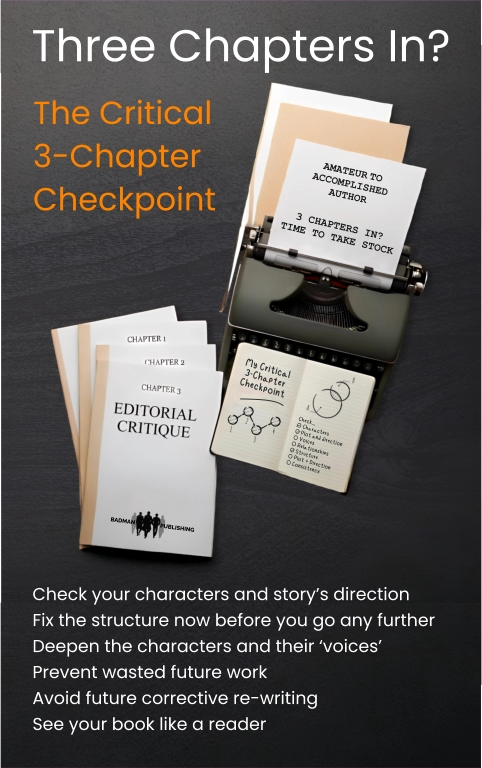
Check your story's direction

Those first chapters usually establish the premise, protagonist, and problem, so pausing lets you confirm the book has a clear hook and direction rather than a vague situation.

A short 'stock‑take' helps you see whether each chapter genuinely pushes the story forward, or whether you are wandering, repeating beats, or stalling in backstory and exposition.

Fix the structure now before you go any further

Three chapters is often enough to reveal structural issues like a slow start, unclear stakes, or missing inciting incident, which are far easier to fix now than after 60k words.

Looking at these chapters side‑by‑side lets you assess pacing and balance between scene, summary, and exposition so the opening act leads naturally into the middle of the book.

Deepen the characters and their 'voices'

By chapter three you usually understand your characters better than you did on page one, so revisiting the opening allows you to align their early behaviour and dialogue with who they have already become.

A pause helps you smooth out shifts in style or tone that creep in as you warm up, giving the book a more consistent narrative 'voice' from the outset.

Prevent wasted future work - avoid future corrective re-writing

Taking stock can expose dead‑end subplots or worldbuilding ideas now, so you can adjust your informal outline or notes instead of cutting entire later chapters.

Even if you are discovery writing, a brief review of what you have teaches you what the story wants to be, making future scenes easier and reducing the amount of heavy revision needed later.

See your book like a reader

Stepping back, even for a short time, lets you return to those chapters with enough distance to spot confusion, flat moments, or missing emotional beats that you were blind to while drafting.

Reading the first three as a continuous unit gives you a reader’s‑eye view of your opening act: would you, as a stranger, feel compelled to keep turning pages into chapter four?


The 3-Chapters-In Editorial Pack

Editorial Pack Featured image for Badman Publishing

To help you "take stock" of your story so far, you can upload the first three chapters of your manuscript.

We will analyse your submitted first three chapters and present you with the following:

1. A focused spelling and grammar check highlighting errors to remedy.

2. A full critique providing a critique of your story, checking character development, plot line, and writing style.

3. A one-page pitch document based on your first three chapters

4. A storyline and plot planner to help you refine and adhere to the plot lines and time lines

5. Access to our writing and publishing focused resources

The Editorial Pack (COMING 2026)

Click here for more information about your bespoke editorial pack contents, example documents and pricing. (Available January 2026)

[dsm_icon_list _builder_version="4.27.5" _module_preset="default" global_colors_info="{}"][/dsm_icon_list]
Please feel free to share this page... Thanks :-)
What Indie Authors Need to Know About Kindle Translate

What Indie Authors Need to Know About Kindle Translate

The options and opportunities of self-publishing is constantly evolving. The pace of change seems to be accelerating, and staying informed is more crucial than ever. 

Introducing Kindle Translate (Beta)

Amazon has launched a potentially game-changing tool for indie authors: Kindle Translate, now in closed beta. This new feature allows authors to translate their eBooks between English and Spanish, as well as German to English, with zero upfront cost. For authors looking to reach new audiences without hiring a translator, this could be a major breakthrough.

Speed & Quality

Amazon promises publication-ready translations within just a few days, backed by internal quality checks. While the exact translation engine hasn’t been disclosed, early testers report that the output is surprisingly polished—though not perfect. As with any automated translation, nuances may be lost, so authors should review carefully before publishing.

Control & Limitations

Authors can preview the translated manuscript before it goes live, which offers a layer of control. However, direct editing of the translated text is not currently supported, meaning you’ll need to accept the translation as-is or opt out. This limitation may be a dealbreaker for authors with complex prose or stylistic nuances.

Cost & Royalties

During the beta phase, Kindle Translate is completely free, and authors retain their standard royalty structure. That’s a rare win in a space where translation services can cost hundreds or even thousands of pounds. It’s worth noting that this may change once the feature exits beta, so early adopters could benefit from getting in now.

Eligibility & KDP Select

Translated editions are eligible for KDP Select enrollment, which means they can participate in Kindle Unlimited and benefit from Amazon’s promotional tools. This opens up new visibility opportunities in Spanish-speaking markets and among German readers seeking English content.

What This Means for Indie Authors

Kindle Translate could dramatically lower the barrier to international publishing. But with great opportunity comes great responsibility. Here’s what authors should be doing in real time:

  • Monitor quality closely: Even with Amazon’s checks, machine translation can miss context or tone.
  • Consider genre fit: Nonfiction and genre fiction with straightforward language may fare better than literary fiction or poetry.
  • Stay informed: As the beta expands, expect changes in supported languages, editing capabilities, and pricing.

Our Advice:

Amazon’s Kindle Translate is a bold step toward democratizing global publishing. For indie authors, it’s a chance to test new markets without upfront investment, but it’s not a set-it-and-forget-it solution. Keep your editorial standards high, stay engaged with the rollout, and be ready to pivot as the feature evolves.

Can we help you with writing, refining and/or publishing?

At Badman Publishing, we understand that navigating the world of independent publishing can be overwhelming — especially when it comes to budgeting for professional services. That’s why we’re committed to making your journey smoother, more affordable, and more empowering.

Whether you're looking for editorial support, design expertise, publishing guidance, or marketing tools, we offer a range of services, some of which are free, or low cost — tailored to independent authors like you. Our goal is to help you focus on what matters most: writing and sharing your story.

We’re here to support you. Reach out to us at Badman, or explore our resources and services pages to see how we can collaborate.

"Let’s bring your book to life — together."

The publishing cycle Badman Publishing post image 1616x100x96
Please feel free to share this page... Thanks :-)