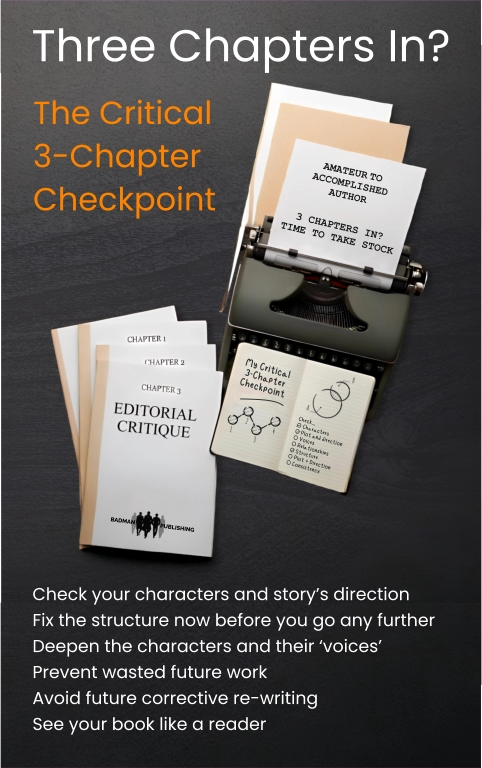

Why we have written this article...
Unfortunately, we continue to receive manuscripts from independent authors who believe their book is ready to publish. Sadly, upon reviewing their manuscript, we find hundreds of errors that really should not be in the finished, ready-to-publish book.
What we find distressing is that some of these authors have paid, in some cases, substantial 'professional' fees to third parties to review, audit and edit their book.
Despite paying these fees for proof reading and corrective services, some of the manuscripts we receive are still full of spelling and grammar errors, character and plot inconsistencies and sometimes a little confusion and contradiction within the narrative.
In an effort to remedy this and provide a bit of advice and guidance, as well as a prfactical tool, this article is split into two sections:
1 - Three chapters in? - Why It's time to take stock.
Why it is critical to stop writing once you have written, and after self-editing, are happy with your first three chapters, or 1,000 words.
2 -The Three Chapters in Editorial Pack
Using our "3-Chapters in Editorial Pack" to provide an independent check of your manuscript, not just the spelling and grammar, but the key aspects of your writing that you need to check before continuing to write or submitting your pitch to a literary agent or Publisher.
Critical 3-Chapters-In Checkpoint
Three chapters in? - Why It's time to take stock.
Pausing your writing after three chapters, about one thousand words, lets you check that the story you are actually writing matches the story you think you are writing, before you invest tens of thousands more words in the wrong direction.
Why is doing this Critical 3-Chapter Check so important for your book?

Check your story's direction
Those first chapters usually establish the premise, protagonist, and problem, so pausing lets you confirm the book has a clear hook and direction rather than a vague situation.
A short 'stock‑take' helps you see whether each chapter genuinely pushes the story forward, or whether you are wandering, repeating beats, or stalling in backstory and exposition.
Fix the structure now before you go any further
Three chapters is often enough to reveal structural issues like a slow start, unclear stakes, or missing inciting incident, which are far easier to fix now than after 60k words.
Looking at these chapters side‑by‑side lets you assess pacing and balance between scene, summary, and exposition so the opening act leads naturally into the middle of the book.
Deepen the characters and their 'voices'
By chapter three you usually understand your characters better than you did on page one, so revisiting the opening allows you to align their early behaviour and dialogue with who they have already become.
A pause helps you smooth out shifts in style or tone that creep in as you warm up, giving the book a more consistent narrative 'voice' from the outset.
Prevent wasted future work - avoid future corrective re-writing
Taking stock can expose dead‑end subplots or worldbuilding ideas now, so you can adjust your informal outline or notes instead of cutting entire later chapters.
Even if you are discovery writing, a brief review of what you have teaches you what the story wants to be, making future scenes easier and reducing the amount of heavy revision needed later.
See your book like a reader
Stepping back, even for a short time, lets you return to those chapters with enough distance to spot confusion, flat moments, or missing emotional beats that you were blind to while drafting.
Reading the first three as a continuous unit gives you a reader’s‑eye view of your opening act: would you, as a stranger, feel compelled to keep turning pages into chapter four?
The 3-Chapters-In Editorial Pack

To help you "take stock" of your story so far, you can upload the first three chapters of your manuscript.
We will analyse your submitted first three chapters and present you with the following:
1. A focused spelling and grammar check highlighting errors to remedy.
2. A full critique providing a critique of your story, checking character development, plot line, and writing style.
3. A one-page pitch document based on your first three chapters
4. A storyline and plot planner to help you refine and adhere to the plot lines and time lines
5. Access to our writing and publishing focused resources
The Editorial Pack (COMING 2026)
Click here for more information about your bespoke editorial pack contents, example documents and pricing. (Available January 2026)